
RF Performance Is a Bill of Materials Problem
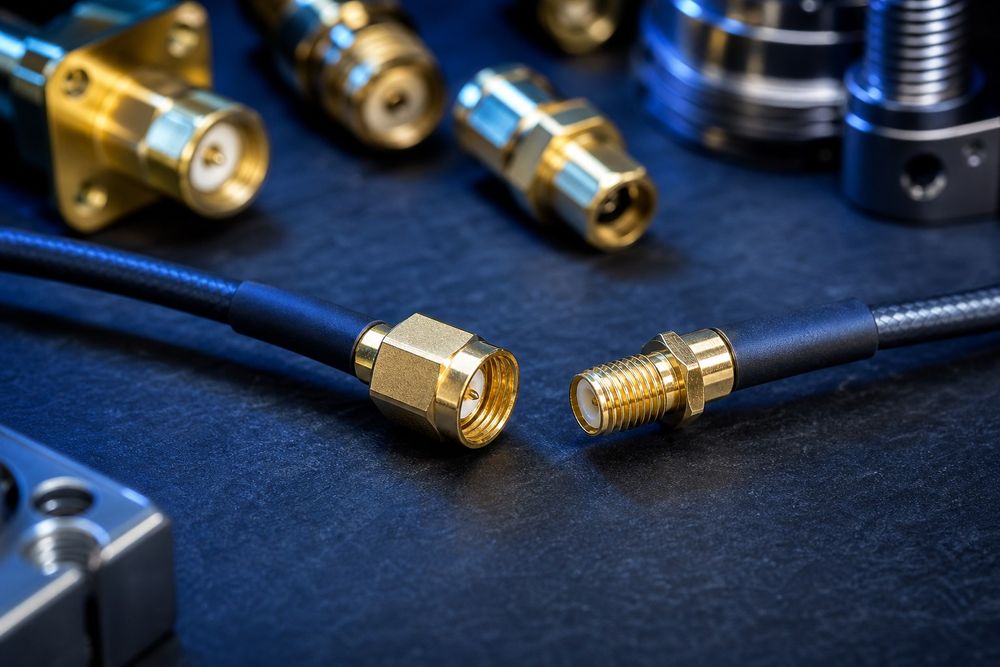
Connectors, cables, and PCB launch regions must share impedance and return path discipline. Restar customers quote SMA, IPEX, N-Type, and custom cable assemblies on one RFQ with frequency range, power, and environmental sealing requirements.
A perfect module fails field QA when a pigtail cable uses the wrong velocity factor or a marginal connector torque spec.
This guide explains matching essentials, franchise coax brands, and procurement data fields for telecom and industrial RF subsystems.
Impedance, Return Loss, and Launch Geometry
Specify 50 Ω versus 75 Ω explicitly; mixed systems need adapters called out as separate BOM lines with approved vendors.
PCB launch footprints must match connector vendor land patterns—procurement alternates must be pin-compatible, not merely thread-compatible.
Pair connector RFQs with protection devices on exposed ports.
Cable Loss and Bend Radius
Document cable type (RG178, LMR, etc.), length, and bend radius limits for robotic or outdoor installs.
Restar quotes factory-terminated assemblies with test reports when manufacturers provide them.
Use categoryAll to locate complementary passives for bias tees and filter networks.
Environmental and Mechanical Ratings
Outdoor telecom connectors need IP rating and UV-stable materials; capture temperature cycle and salt fog needs on RFQ.
Torque wrenches and plating options (gold versus nickel) affect PIM in cellular infrastructure—state PIM budget if applicable.
Follow product update posts on news for RF component lead-time shifts.
Inventory and Kitting
Kit RF connectors with modules and antennas to reduce mismatched spares in warehouse kitted BOMs.
Reel versus tray packaging matters for high-volume IoT; declare EMS feeder type.
Visit manufacturers for franchise coax suppliers before approving alternates.
Restar Quoting and Quality
Quotes include insertion loss estimates when provided by manufacturers, MOQ for custom lengths, and hub stock for standard pigtails.
Combine with RFQ lines for ESD devices on the same connector panel.
See solutions telecom pages for reference interconnect BOMs when redesigning.
Restar editorial and inside sales teams treat every BOM line as a lifecycle decision: factory lead time, hub availability in Shenzhen, MOQ/SPQ, and reel size are quoted together so planners can reconcile MRP dates with realistic inbound receipts rather than binary in-stock flags.
When you upload spreadsheets to the RFQ portal, include full manufacturer suffixes, target build dates, and whether ranked alternates are approved. Restar matching uses franchise datasheets, PCN notices, and parametric filters—not unverified cross-reference aggregators—to propose A/B alternates.
For automotive, industrial, and telecom programs, Restar can provide lot traceability, MSL discipline, and incoming inspection summaries on request, aligning component packaging with your EMS paste, reflow, and depanelization rules to reduce combined failure modes on passives and discretes.
After exploratory searches on categoryAll, anchor approved MPNs on the RFQ to minimize quote churn. Monitor the news center for lead-time drift and EOL advisories so you can reserve factory slots for long-lead capacitors, PMICs, and RF modules before allocation hardens.
If export compliance or AEC-Q qualifications apply, declare them in RFQ notes so quotes attach the correct document paths for RoHS, REACH, and PPAP expectations before purchase order release.
Authenticity matters on shortage markets: Restar does not blend anonymous broker lots with franchise inventory without explicit customer consent, and can escalate X-ray or decapsulation on directed sample lots for high-risk legacy MPNs.
Combine RFQ lines that ship together—MLCC bulk caps, ESD/TVS devices, RF connectors—to optimize freight, customs, and invoice alignment on Shenzhen outbound handling.
Design reviews should capture DC bias, temperature corners, and flex stress for every MLCC downsize decision; procurement can only source reliably when engineering context travels with the BOM.
Restar editorial and inside sales teams treat every BOM line as a lifecycle decision: factory lead time, hub availability in Shenzhen, MOQ/SPQ, and reel size are quoted together so planners can reconcile MRP dates with realistic inbound receipts rather than binary in-stock flags.
When you upload spreadsheets to the RFQ portal, include full manufacturer suffixes, target build dates, and whether ranked alternates are approved. Restar matching uses franchise datasheets, PCN notices, and parametric filters—not unverified cross-reference aggregators—to propose A/B alternates.
For automotive, industrial, and telecom programs, Restar can provide lot traceability, MSL discipline, and incoming inspection summaries on request, aligning component packaging with your EMS paste, reflow, and depanelization rules to reduce combined failure modes on passives and discretes.
After exploratory searches on categoryAll, anchor approved MPNs on the RFQ to minimize quote churn. Monitor the news center for lead-time drift and EOL advisories so you can reserve factory slots for long-lead capacitors, PMICs, and RF modules before allocation hardens.
If export compliance or AEC-Q qualifications apply, declare them in RFQ notes so quotes attach the correct document paths for RoHS, REACH, and PPAP expectations before purchase order release.
Authenticity matters on shortage markets: Restar does not blend anonymous broker lots with franchise inventory without explicit customer consent, and can escalate X-ray or decapsulation on directed sample lots for high-risk legacy MPNs.
Combine RFQ lines that ship together—MLCC bulk caps, ESD/TVS devices, RF connectors—to optimize freight, customs, and invoice alignment on Shenzhen outbound handling.
Design reviews should capture DC bias, temperature corners, and flex stress for every MLCC downsize decision; procurement can only source reliably when engineering context travels with the BOM.
Restar editorial and inside sales teams treat every BOM line as a lifecycle decision: factory lead time, hub availability in Shenzhen, MOQ/SPQ, and reel size are quoted together so planners can reconcile MRP dates with realistic inbound receipts rather than binary in-stock flags.
When you upload spreadsheets to the RFQ portal, include full manufacturer suffixes, target build dates, and whether ranked alternates are approved. Restar matching uses franchise datasheets, PCN notices, and parametric filters—not unverified cross-reference aggregators—to propose A/B alternates.
For automotive, industrial, and telecom programs, Restar can provide lot traceability, MSL discipline, and incoming inspection summaries on request, aligning component packaging with your EMS paste, reflow, and depanelization rules to reduce combined failure modes on passives and discretes.
After exploratory searches on categoryAll, anchor approved MPNs on the RFQ to minimize quote churn. Monitor the news center for lead-time drift and EOL advisories so you can reserve factory slots for long-lead capacitors, PMICs, and RF modules before allocation hardens.
If export compliance or AEC-Q qualifications apply, declare them in RFQ notes so quotes attach the correct document paths for RoHS, REACH, and PPAP expectations before purchase order release.
Authenticity matters on shortage markets: Restar does not blend anonymous broker lots with franchise inventory without explicit customer consent, and can escalate X-ray or decapsulation on directed sample lots for high-risk legacy MPNs.
Combine RFQ lines that ship together—MLCC bulk caps, ESD/TVS devices, RF connectors—to optimize freight, customs, and invoice alignment on Shenzhen outbound handling.
Design reviews should capture DC bias, temperature corners, and flex stress for every MLCC downsize decision; procurement can only source reliably when engineering context travels with the BOM.
Restar editorial and inside sales teams treat every BOM line as a lifecycle decision: factory lead time, hub availability in Shenzhen, MOQ/SPQ, and reel size are quoted together so planners can reconcile MRP dates with realistic inbound receipts rather than binary in-stock flags.
When you upload spreadsheets to the RFQ portal, include full manufacturer suffixes, target build dates, and whether ranked alternates are approved. Restar matching uses franchise datasheets, PCN notices, and parametric filters—not unverified cross-reference aggregators—to propose A/B alternates.
For automotive, industrial, and telecom programs, Restar can provide lot traceability, MSL discipline, and incoming inspection summaries on request, aligning component packaging with your EMS paste, reflow, and depanelization rules to reduce combined failure modes on passives and discretes.
After exploratory searches on categoryAll, anchor approved MPNs on the RFQ to minimize quote churn. Monitor the news center for lead-time drift and EOL advisories so you can reserve factory slots for long-lead capacitors, PMICs, and RF modules before allocation hardens.
If export compliance or AEC-Q qualifications apply, declare them in RFQ notes so quotes attach the correct document paths for RoHS, REACH, and PPAP expectations before purchase order release.
Authenticity matters on shortage markets: Restar does not blend anonymous broker lots with franchise inventory without explicit customer consent, and can escalate X-ray or decapsulation on directed sample lots for high-risk legacy MPNs.
Combine RFQ lines that ship together—MLCC bulk caps, ESD/TVS devices, RF connectors—to optimize freight, customs, and invoice alignment on Shenzhen outbound handling.
Design reviews should capture DC bias, temperature corners, and flex stress for every MLCC downsize decision; procurement can only source reliably when engineering context travels with the BOM.
Restar editorial and inside sales teams treat every BOM line as a lifecycle decision: factory lead time, hub availability in Shenzhen, MOQ/SPQ, and reel size are quoted together so planners can reconcile MRP dates with realistic inbound receipts rather than binary in-stock flags.
When you upload spreadsheets to the RFQ portal, include full manufacturer suffixes, target build dates, and whether ranked alternates are approved. Restar matching uses franchise datasheets, PCN notices, and parametric filters—not unverified cross-reference aggregators—to propose A/B alternates.
For automotive, industrial, and telecom programs, Restar can provide lot traceability, MSL discipline, and incoming inspection summaries on request, aligning component packaging with your EMS paste, reflow, and depanelization rules to reduce combined failure modes on passives and discretes.
After exploratory searches on categoryAll, anchor approved MPNs on the RFQ to minimize quote churn. Monitor the news center for lead-time drift and EOL advisories so you can reserve factory slots for long-lead capacitors, PMICs, and RF modules before allocation hardens.
If export compliance or AEC-Q qualifications apply, declare them in RFQ notes so quotes attach the correct document paths for RoHS, REACH, and PPAP expectations before purchase order release.
Authenticity matters on shortage markets: Restar does not blend anonymous broker lots with franchise inventory without explicit customer consent, and can escalate X-ray or decapsulation on directed sample lots for high-risk legacy MPNs.
Combine RFQ lines that ship together—MLCC bulk caps, ESD/TVS devices, RF connectors—to optimize freight, customs, and invoice alignment on Shenzhen outbound handling.
Design reviews should capture DC bias, temperature corners, and flex stress for every MLCC downsize decision; procurement can only source reliably when engineering context travels with the BOM.
Restar editorial and inside sales teams treat every BOM line as a lifecycle decision: factory lead time, hub availability in Shenzhen, MOQ/SPQ, and reel size are quoted together so planners can reconcile MRP dates with realistic inbound receipts rather than binary in-stock flags.
When you upload spreadsheets to the RFQ portal, include full manufacturer suffixes, target build dates, and whether ranked alternates are approved. Restar matching uses franchise datasheets, PCN notices, and parametric filters—not unverified cross-reference aggregators—to propose A/B alternates.
For automotive, industrial, and telecom programs, Restar can provide lot traceability, MSL discipline, and incoming inspection summaries on request, aligning component packaging with your EMS paste, reflow, and depanelization rules to reduce combined failure modes on passives and discretes.
After exploratory searches on categoryAll, anchor approved MPNs on the RFQ to minimize quote churn. Monitor the news center for lead-time drift and EOL advisories so you can reserve factory slots for long-lead capacitors, PMICs, and RF modules before allocation hardens.
If export compliance or AEC-Q qualifications apply, declare them in RFQ notes so quotes attach the correct document paths for RoHS, REACH, and PPAP expectations before purchase order release.